

HSE University Becomes Absolute Leader in AI Alliance Ranking of Universities

The AI Alliance Russia has announced a new ranking of Russian universities based on the quality of education in the field of AI. A total of 203 universities from 68 Russian regions participated in the ranking. HSE University was the first to join the highest A++ group.
This is the third time the ranking has been released. It features universities offering bachelor's and specialist's programmes in artificial intelligence that are divided into groups depending on the quality of training.
HSE University has become the absolute leader of the list, having entered the highest A++ category—a new group formed for the first time this year.
The assessment is based on open data and independent research by the AI Alliance Russia, including an extensive survey of employers (more than 150 companies), a survey of students on the quality of the educational environment (over 12,000 students), as well as data verification through universities' accounts, which has increased the transparency and reliability of analytics.

Valery Falkov
‘The AI Alliance Russia brings together representatives from the university community and business who discuss the challenges faced by the higher education system as artificial intelligence is increasingly integrated into various sectors of the economy. One significant outcome of this collaboration was the establishment of a university ranking based on the quality of AI education,’ said Valery Falkov, Minister of Science and Higher Education of the Russian Federation.

Alexander Vedyakhin
Alexander Vedyakhin, First Deputy Chairman of the Executive Board of Sberbank and Chairman of the Supervisory Board of the AI Alliance, is convinced that the university's ranking of AI education quality not only reflects the level of Russian education in this field, but also serves as a roadmap for the development of Russia’s digital economy and technological sovereignty. ‘Investments in human capital and collaboration of science, education, and business create a solid foundation for innovation, driving national progress and enhancing the country's global competitiveness in the age of AI,’ he stressed.
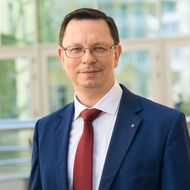
Nikita Anisimov, HSE University Rector
‘Our success in the AI Alliance ranking results from the efforts of the entire ecosystem of the university and its partners, leaders of the IT industry. Today a high level of digital culture is common among both students and staff of HSE University, and research in artificial intelligence is becoming increasingly multidisciplinary.
Cooperation with leading Russian technology companies is our priority. We jointly implement degree programmes, conduct fundamental research, and introduce applied projects. Our goal is not only to strengthen AI competencies, but also to use new technology to help the country address key national development challenges.’
At HSE University, the leader of the AI Alliance ranking, students of all majors gain digital skills and learn how to use AI technologies. The Faculty of Computer Science and other departments of the university, together with leading industrial partners, have launched degree programmes in artificial intelligence. AI is also being actively developed at other HSE campuses.

Ivan Arzhantsev, Dean of the HSE Faculty of Computer Science
HSE University has achieved the top position in the AI Alliance rankings for universities based on the quality of their education in the field of AI. This is a significant achievement for us. We believe that it is the result of our strategy that combines fundamental research in AI with industrial partnerships. At the Faculty of Computer Science, we focus not only on training specialists but also on creating an ecosystem where science, education, and industry go hand in hand to drive innovation and development in the field of artificial intelligence.’

Mikhail Mukhin, Dean of the School of Computer Science, Physics and Technology at HSE Univesity in St Petersburg
‘The leading position of HSE University in the AI Alliance ranking is a reflection of our systematic efforts to provide the best education in this field. By launching the School of Computer Science, Physics, and Technology at our St. Petersburg campus, in collaboration with VK, we have created a unique ecosystem for training AI professionals. Our success demonstrates the power of combining academic excellence with practical experience from industry partners.’

Sergey Roshchin, HSE University Vice Rector
‘The ranking results are extremely significant for our university. First of all, this is an external assessment by leading employers in the BigTech field, united in the AI Alliance. This evaluation confirms the high standard of education and the effectiveness of the educational model we have chosen, which provides that all university students acquire digital competencies and skills for working with AI. In addition, it’s should be noted that HSE managed to move into the A++ group for the first time. This indicates recognition of our successful development, ability to respond to new challenges, and achievement of technological leadership.’

See also:

AI Users Earn Up to 41.8% More Than Non-Users
Research conducted by economists at HSE University has revealed a significant correlation between the regular use of GenAI in the workplace and higher pay among Russian employees. The study found that individuals who frequently use GenAI in their professional activities earn notably more than those who reject these new tools or resort to them occasionally. The salary premium for highly qualified specialists reaches 41.8%. The article was published in the Voprosy Ekonomiki journal.
AI Robot for Environmental Recognition Tested at HSE University
Engineers and researchers at the HSE Institute for Robotics Systems have successfully run the first tests of an AI-powered environmental recognition model deployed on a robot dog. The robot navigated around the HSE Pokrovka building and Pokrovsky Bulvar, analysing the surrounding environment to identify its location.
Algebra, Geometry, and AI: Russian and Vietnamese Mathematicians Discuss Current Research
A delegation of scientists from Hanoi visited the HSE Faculty of Computer Science and then took part in a Russian-Vietnamese conference in St Petersburg. The events were part of the three-year project ‘Flexibility and Computational Methods.’ Over the course of the project, the researchers have prepared joint publications and obtained new mathematical results.
HSE Researchers Present Study on Neural Network Robustness in Video Analysis at ChinaMM 2026
Researchers from HSE University presented a study at the international ChinaMM 2026 conference on how video transmission distortions affect the performance of neural networks. The authors proposed a new approach to testing the robustness of such models under conditions that closely resemble the real-world use of video services.
HSE University to Develop Predictive Analytics System for Icebreaker Motors
Industrial automation is one of the key applications of artificial intelligence. A predictive analytics system for large electric motors is among the solutions being developed for the industry as part of HSE University’s Strategic Technological Project ‘Multi-Agent Platform of AI Solutions for Industry-Specific Tasks.’ What is predictive analytics, how can it improve the operation of electric motors, and what specialists joined forces to develop this technology? Anton Zarubin, Dean of the School of Computer Science, Physics, and Technology at HSE University–St Petersburg and the project development coordinator, explains in this interview with the HSE News Service.
Scientific Expedition to Hainan: HSE Scientists Organise Conference on Statistical AI in China
The Statistical AI Conference was held in Sanya, Hainan Island, China, from 24 to 28 August 2026. The international event brought together leading experts in statistics, machine learning, and applied AI. Alexey Naumov, Director of the AI and Digital Science Institute at the HSE Faculty of Computer Science, and Sergey Samsonov, Head of the International Laboratory of Stochastic Algorithms and High-Dimensional Inference, were among the conference organisers.
How to Assess Students’ Knowledge in the Age of AI
A researcher at HSE University has proposed a flowchart to help lecturers decide how to assess students who use artificial intelligence. It shows where the use of AI should be restricted and where it can be incorporated into the learning process. The article has been published in IT Professional.
5th Fall into ML Conference to Bring Together Leading AI Researchers
The AI and Digital Science Institute at the HSE Faculty of Computer Science invites researchers, developers and everyone shaping the future of technology to the fifth, anniversary edition of the Fall into Machine Learning conference (Fall into ML 2026). The event will take place on October 23–24, 2026, at the HSE Cultural Centre in Moscow and will become the key meeting point for Russia’s AI community.
HSE University to Present Its Projects at the International Youth Festival
The International Youth Festival (IYF) will be held in Yekaterinburg from 11 to 17 September 2026. HSE University will take an active part in the event. The university's booth will present a space settlement mock-up, robots, and the iFORA big data analysis system. Fifty HSE students will visit festival venues, and experts will participate in the business programme.
HSE University Expands Cooperation with Malaysia in Technology Foresight
HSE University researchers will take part in a study of the future of engineering education in Malaysia, while the Malaysian Industry-Government Group for High Technology (MIGHT) will use the iFORA big-data analysis system to validate the findings of its foresight research. These are the outcomes of a visit by HSE representatives to Kuala Lumpur.