

HSE Scientists Test New Method to Investigate Mechanisms of New Word Acquisition

Researchers at the HSE Centre for Language and Brain were among the first to use transcranial alternating current stimulation to investigate whether it can influence the acquisition of new words. Although the authors of the experiment have not yet found a link between brain stimulation and word acquisition, they believe that adjusting the stimulation parameters may yield different results in the future. The study has been published in Language, Cognition and Neuroscience.
The ability to acquire and appropriately use new words is essential for effective human communication. Throughout life, people continue to learn new words in their native language and also master foreign languages. Acquiring new words is a complex cognitive process, and its underlying mechanisms remain poorly understood.
Modern neuroimaging techniques—such as electroencephalography, magnetic resonance imaging, and magnetoencephalography—allow researchers to look inside the brain and observe which regions are activated during specific cognitive processes. However, it remains impossible to determine whether the relationship between stimulation and brain processes is causal or merely coincidental. The use of alternating current in experiments changes the approach: it allows for modulating rhythms at specific frequencies and tracking their role in neural processes.
Researchers at the HSE Centre for Language and Brain were among the first to investigate whether weak electrical stimulation of the brain at the theta frequency can help memorise new words. The scientists recruited 30 healthy volunteers and asked them to learn 80 pseudowords paired with Russian nouns. During the training, participants received low-current brain stimulation at theta rhythm frequencies (3.5–7.5 Hz) over the left frontotemporal regions of the brain, which are associated with speech and memory. The theta frequency band was deliberately chosen, because previous studies have shown that theta rhythms play a key role in transferring information from short-term to long-term memory.
After participants learned the words with stimulation, the researchers tested their memory retention. There was also a separate phase of learning and testing without stimulation to compare participants’ performance.
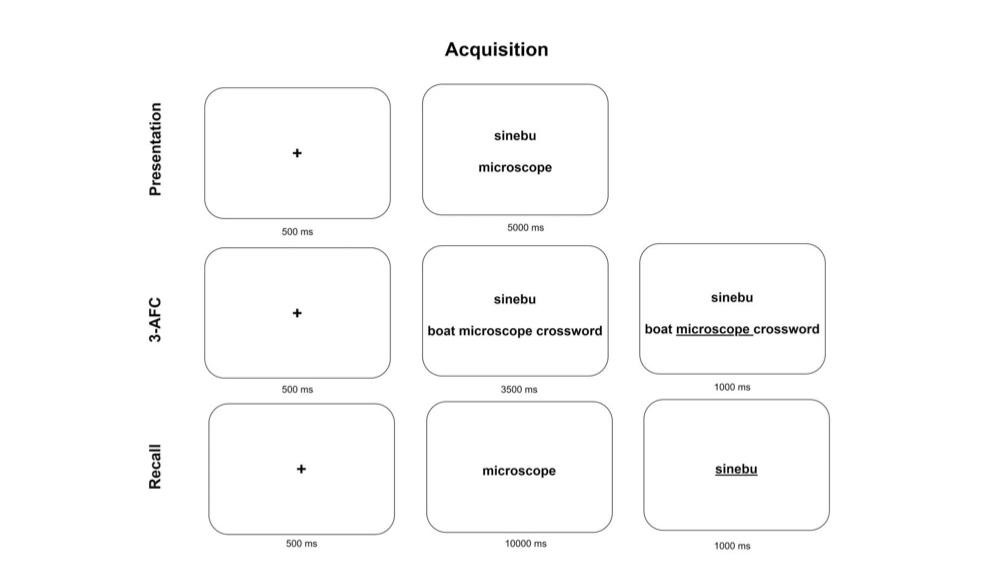
No improvement was observed in new word acquisition with stimulation compared to the control condition. The authors note that learning new words activates complex neural networks involving both the cerebral cortex and the hippocampus, which is difficult to stimulate noninvasively from the surface of the head.

Anna Komissarenko
'Although our study did not find a direct effect of alternating current stimulation on word acquisition, we still made an important step toward developing new methods to support language learning. We will continue our research in this direction, but future experiments will focus on other brain regions and types of stimulation,' explains Anna Komissarenko, Junior Research Fellow at the HSE Centre for Language and Brain and lead author of the paper.
In the future, the team plans to test different frequency bands and phases of electrical stimulation, change electrode placement, and expand the experiments to explore various cognitive functions. This can help deepen our understanding of how the brain’s electrical activity influences learning and memory, potentially leading to the development of accelerated language learning techniques, rehabilitation programmes for stroke and injury patients, and optimised neurostimulation methods to enhance memory.

See also:

HSE University to Develop Predictive Analytics System for Icebreaker Motors
Industrial automation is one of the key applications of artificial intelligence. A predictive analytics system for large electric motors is among the solutions being developed for the industry as part of HSE University’s Strategic Technological Project ‘Multi-Agent Platform of AI Solutions for Industry-Specific Tasks.’ What is predictive analytics, how can it improve the operation of electric motors, and what specialists joined forces to develop this technology? Anton Zarubin, Dean of the School of Computer Science, Physics, and Technology at HSE University–St Petersburg and the project development coordinator, explains in this interview with the HSE News Service.
How to Assess Students’ Knowledge in the Age of AI
A researcher at HSE University has proposed a flowchart to help lecturers decide how to assess students who use artificial intelligence. It shows where the use of AI should be restricted and where it can be incorporated into the learning process. The article has been published in IT Professional.
5th Fall into ML Conference to Bring Together Leading AI Researchers
The AI and Digital Science Institute at the HSE Faculty of Computer Science invites researchers, developers and everyone shaping the future of technology to the fifth, anniversary edition of the Fall into Machine Learning conference (Fall into ML 2026). The event will take place on October 23–24, 2026, at the HSE Cultural Centre in Moscow and will become the key meeting point for Russia’s AI community.
HSE University Expands Cooperation with Malaysia in Technology Foresight
HSE University researchers will take part in a study of the future of engineering education in Malaysia, while the Malaysian Industry-Government Group for High Technology (MIGHT) will use the iFORA big-data analysis system to validate the findings of its foresight research. These are the outcomes of a visit by HSE representatives to Kuala Lumpur.
Scientists Train Neural Network to Generate Process Plans from 3D Models
Researchers at the HSE FCS AI and Digital Science Institute have developed CAD2TechSpec, a framework that converts 3D models of mechanical parts into machining process plans—step-by-step instructions for machine tools. The solution aims to reduce the time required for the design and preparation of technical process documentation in mechanical engineering, aircraft manufacturing, and other high-tech industries. The study findings have been published in PeerJ Computer Science.
Biologists Discover 'Molecular Fingerprint' of Preeclampsia
Researchers at HSE University employed a new method to model hypoxia in placental cells during pregnancies complicated by preeclampsia and identified molecular markers of tissue hypoxia. Since hypoxia is one of the key mechanisms underlying preeclampsia, these findings are important for a more accurate and timely diagnosis of the disease and for the development of effective treatment methods. The paper has been published in Placenta.
Laboratory of Future Networks: HSE Telecommunications Research Institute Develops 5G/6G Research Testbed
The 5G/6G testbed at the HSE Telecommunications Research Institute is becoming a research platform, an educational laboratory, and a foundation for developing new software components for future networks. It makes it possible not only to observe how a mobile network operates, but also to change its operating conditions and measure the results: data-transmission speed, latency, errors, radio-resource utilisation, and other parameters. Based on the testbed, researchers plan to develop MIMO, O-RAN, xApp, and IAB technologies, as well as experiment with artificial intelligence.
‘Hedgehog’ Versus ‘Relatives’: Researchers Measure How the Brain Responds to Unexpected Words During Natural Speech
Russian neurophysiologists, including researchers from HSE University, have demonstrated the feasibility of using event-related fields (ERFs) to study brain activity during natural speech perception. The researchers showed that this approach can be applied not only to individual words but also to continuous speech. Their findings indicate that words whose meanings differ significantly from the preceding context require longer processing times. The study also reveals that the brain processes function words in two stages: first, it identifies their grammatical role and then uses this information to predict the next word. The study has been published in Frontiers in Human Neuroscience.
HSE Researchers Create New Corpus of Early Child Speech in Russian
Researchers at the HSE Centre for Language and Brain have presented RusLan-M, an open multimedia corpus that makes it possible to trace the development of early child speech in Russian from first words to the emergence of complex grammatical constructions. The database contains around 41 hours of video recordings and more than 35,000 child utterances. The new resource will help researchers study more precisely how children acquire Russian and, in the longer term, develop more reliable tools for assessing speech development. The study has been published in Language Resources and Evaluation.
Hybrid Intelligence: Competencies in the Age of AI Discussed at Technoprom-2026
Artificial intelligence is not creating new professions, but rather transforming the nature of existing ones. This was the conclusion reached by participants in the panel session ‘Hybrid Intelligence: Digital and Human Drivers of Development,’ organised by the Institute for Statistical Studies and Economics of Knowledge (ISSEK) at HSE University as part of the 13th International Forum of Technological Development (Technoprom-2026). The experts discussed how the nature of work is changing, which skills are becoming increasingly sought after, and what prevents companies from fully capitalising on new technologies.