

Scientists Discover How Correlated Disorder Boosts Superconductivity

Superconductivity is a unique state of matter in which electric current flows without any energy loss. In materials with defects, it typically emerges at very low temperatures and develops in several stages. An international team of scientists, including physicists from HSE MIEM, has demonstrated that when defects within a material are arranged in a specific pattern rather than randomly, superconductivity can occur at a higher temperature and extend throughout the entire material. This discovery could help develop superconductors that operate without the need for extreme cooling. The study has been published in Physical Review B.
Superconductivity is a state in which electric current flows through a material without any energy loss. In conventional conductors, part of the energy is converted into heat, but in superconductors, this does not occur—current flows freely and does not weaken. Today, superconductors are used in applications such as MRI machines, where superconducting coils generate strong magnetic fields. In the future, superconductors may also be integrated into systems that require lossless power transmission and high-speed signal processing. The challenge is that nearly all superconductors function only at temperatures below -140 °C, which limits their practical use. To make them more viable, physicists are working to raise their operating temperature and improve stability.
Researchers from the HSE MIEM Centre for Quantum Metamaterials, in collaboration with colleagues from MEPhI, MIPT, and the Federal University of Pernambuco, Brazil, have shown that superconductivity can be made more stable by controlling the placement of defects. Defects are deviations from a material’s ideal crystal lattice, such as excess or missing atoms, impurities, and distortions. They usually disrupt the movement of electrons and weaken superconductivity, but it is impossible to eliminate them entirely, especially in multicomponent materials. Rather than eliminating these imperfections, the scientists have proposed arranging them in a specific pattern. This type of defect distribution is known as correlated disorder.
Alexei Vagov
'Imagine a crowd of people moving chaotically in different directions—that’s a classic example of disorder. Now imagine the same crowd moving in a complex but coordinated pattern, like a mass dance—that illustrates correlated disorder,' says Alexei Vagov, Professor at the HSE Tikhonov Moscow Institute of Electronics and Mathematics. 'In superconductors, it turns out that this kind of order within disorder causes defects to actually enhance superconductivity.'
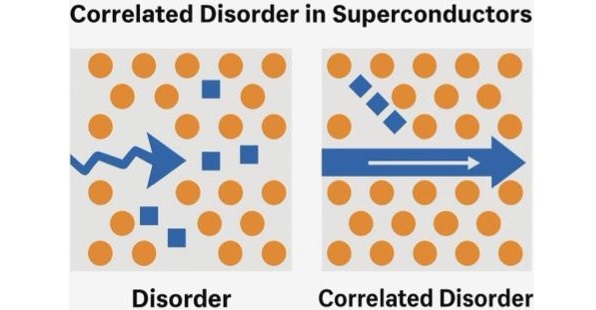
In materials with defects, superconductivity typically develops in two stages. First, isolated regions appear where superconductivity begins to emerge. Then, as the temperature drops, these regions connect, allowing current to flow throughout the entire sample. Scientists have modelled a two-dimensional superconductor with varying defect distributions—from random to correlated, where impurities are interconnected. The results show that when disorder in the material is coordinated rather than chaotic, the transition happens immediately: superconductivity emerges simultaneously throughout the entire system.
The scientists believe these findings could aid in the development of thin superconducting films, whose structures closely resemble the model used in the study. When synthesising such films, it is possible to control the placement of defects in advance, which is useful both for testing the theory and for creating materials with specified properties.
'Controlling the placement of defects at the microscopic level could enable the creation of superconductors that operate at much higher temperatures—potentially even at room temperature. This would transform superconductivity from a laboratory rarity into a technology used in everyday devices,' comments Alexei Vagov.
The study was conducted with support from the Ministry of Education and Science, Grant 075-15-2025-010, and HSE University's Basic Research Programme within the framework of the Centres of Excellence project.

See also:

HSE University to Develop Predictive Analytics System for Icebreaker Motors
Industrial automation is one of the key applications of artificial intelligence. A predictive analytics system for large electric motors is among the solutions being developed for the industry as part of HSE University’s Strategic Technological Project ‘Multi-Agent Platform of AI Solutions for Industry-Specific Tasks.’ What is predictive analytics, how can it improve the operation of electric motors, and what specialists joined forces to develop this technology? Anton Zarubin, Dean of the School of Computer Science, Physics, and Technology at HSE University–St Petersburg and the project development coordinator, explains in this interview with the HSE News Service.
How to Assess Students’ Knowledge in the Age of AI
A researcher at HSE University has proposed a flowchart to help lecturers decide how to assess students who use artificial intelligence. It shows where the use of AI should be restricted and where it can be incorporated into the learning process. The article has been published in IT Professional.
5th Fall into ML Conference to Bring Together Leading AI Researchers
The AI and Digital Science Institute at the HSE Faculty of Computer Science invites researchers, developers and everyone shaping the future of technology to the fifth, anniversary edition of the Fall into Machine Learning conference (Fall into ML 2026). The event will take place on October 23–24, 2026, at the HSE Cultural Centre in Moscow and will become the key meeting point for Russia’s AI community.
HSE University Expands Cooperation with Malaysia in Technology Foresight
HSE University researchers will take part in a study of the future of engineering education in Malaysia, while the Malaysian Industry-Government Group for High Technology (MIGHT) will use the iFORA big-data analysis system to validate the findings of its foresight research. These are the outcomes of a visit by HSE representatives to Kuala Lumpur.
Scientists Train Neural Network to Generate Process Plans from 3D Models
Researchers at the HSE FCS AI and Digital Science Institute have developed CAD2TechSpec, a framework that converts 3D models of mechanical parts into machining process plans—step-by-step instructions for machine tools. The solution aims to reduce the time required for the design and preparation of technical process documentation in mechanical engineering, aircraft manufacturing, and other high-tech industries. The study findings have been published in PeerJ Computer Science.
Biologists Discover 'Molecular Fingerprint' of Preeclampsia
Researchers at HSE University employed a new method to model hypoxia in placental cells during pregnancies complicated by preeclampsia and identified molecular markers of tissue hypoxia. Since hypoxia is one of the key mechanisms underlying preeclampsia, these findings are important for a more accurate and timely diagnosis of the disease and for the development of effective treatment methods. The paper has been published in Placenta.
Laboratory of Future Networks: HSE Telecommunications Research Institute Develops 5G/6G Research Testbed
The 5G/6G testbed at the HSE Telecommunications Research Institute is becoming a research platform, an educational laboratory, and a foundation for developing new software components for future networks. It makes it possible not only to observe how a mobile network operates, but also to change its operating conditions and measure the results: data-transmission speed, latency, errors, radio-resource utilisation, and other parameters. Based on the testbed, researchers plan to develop MIMO, O-RAN, xApp, and IAB technologies, as well as experiment with artificial intelligence.
‘Hedgehog’ Versus ‘Relatives’: Researchers Measure How the Brain Responds to Unexpected Words During Natural Speech
Russian neurophysiologists, including researchers from HSE University, have demonstrated the feasibility of using event-related fields (ERFs) to study brain activity during natural speech perception. The researchers showed that this approach can be applied not only to individual words but also to continuous speech. Their findings indicate that words whose meanings differ significantly from the preceding context require longer processing times. The study also reveals that the brain processes function words in two stages: first, it identifies their grammatical role and then uses this information to predict the next word. The study has been published in Frontiers in Human Neuroscience.
HSE Researchers Create New Corpus of Early Child Speech in Russian
Researchers at the HSE Centre for Language and Brain have presented RusLan-M, an open multimedia corpus that makes it possible to trace the development of early child speech in Russian from first words to the emergence of complex grammatical constructions. The database contains around 41 hours of video recordings and more than 35,000 child utterances. The new resource will help researchers study more precisely how children acquire Russian and, in the longer term, develop more reliable tools for assessing speech development. The study has been published in Language Resources and Evaluation.
Hybrid Intelligence: Competencies in the Age of AI Discussed at Technoprom-2026
Artificial intelligence is not creating new professions, but rather transforming the nature of existing ones. This was the conclusion reached by participants in the panel session ‘Hybrid Intelligence: Digital and Human Drivers of Development,’ organised by the Institute for Statistical Studies and Economics of Knowledge (ISSEK) at HSE University as part of the 13th International Forum of Technological Development (Technoprom-2026). The experts discussed how the nature of work is changing, which skills are becoming increasingly sought after, and what prevents companies from fully capitalising on new technologies.