

‘We Demonstrated That HSE University Can Not Only Build a Satellite, but Maintain Its Operation’

The first HSE University satellite has completed its work in orbit after more than 35,000 hours of trouble-free operation, one billion kilometres travelled (24,600 orbits around the Earth), and hundreds of full-frame shots taken of the Earth's surface across an area of 320,000 km2. The HSE News Service shares the results of the satellite’s mission and the team’s plans for the near future.
The CubeSX-HSE and CubeSX-Sirius-HSE satellites were the first CubeSats launched by HSE University and the Sirius Educational Centre. The global SatNOGS catalogue now lists both devices as ‘Decayed,’ officially signalling the completion of a four-year orbital mission—three times longer than their formal one-year warranty and almost double the statistically reliable limit for standard CubeSat platforms.
Launched on March 22, 2021, on a Soyuz-2.1 commercial flight with a Fregat unit, the pair of three-unit satellites entered a Sun-synchronous orbit about 550 km high alongside three dozen more satellites. The initial estimated life of the OrbiCraft-Pro platform—12 months of active operation—was chosen as a compromise between expense and statistics; according to industry estimates, the probability of maintaining the functionality of a classic CubeSat a year after launch does not exceed 60%. This makes the final outcome all the more impressive: a four-year, trouble-free marathon spanning about one billion km (24,600 orbits), the equivalent of several dozen round trips from Earth to Mars. The final descent began in April–May 2025, when the perigee of both vehicles dropped below 200 km; the calculated models showed a linear increase in aerodynamic drag.
The main scientific programme was carried out by the world's first flat harmonic diffractive lens, with a diameter of 10 mm and embedded in a 3D-printed metal camera box. A series of calibration surveys proved that ultrathin optics produce an image comparable to classical refractive optics; the results are described in an article in Remote Sensing 14 (9): 2230 (2022). In total, the pair of satellites collected more than 320 full-frame shots of the Earth's surface, from the cellular clouds of the Barents Sea to the spring flood on the Volga, with a total area of over 300,000 km2, a milestone recorded by the HSE team at the three-year mark of the mission.
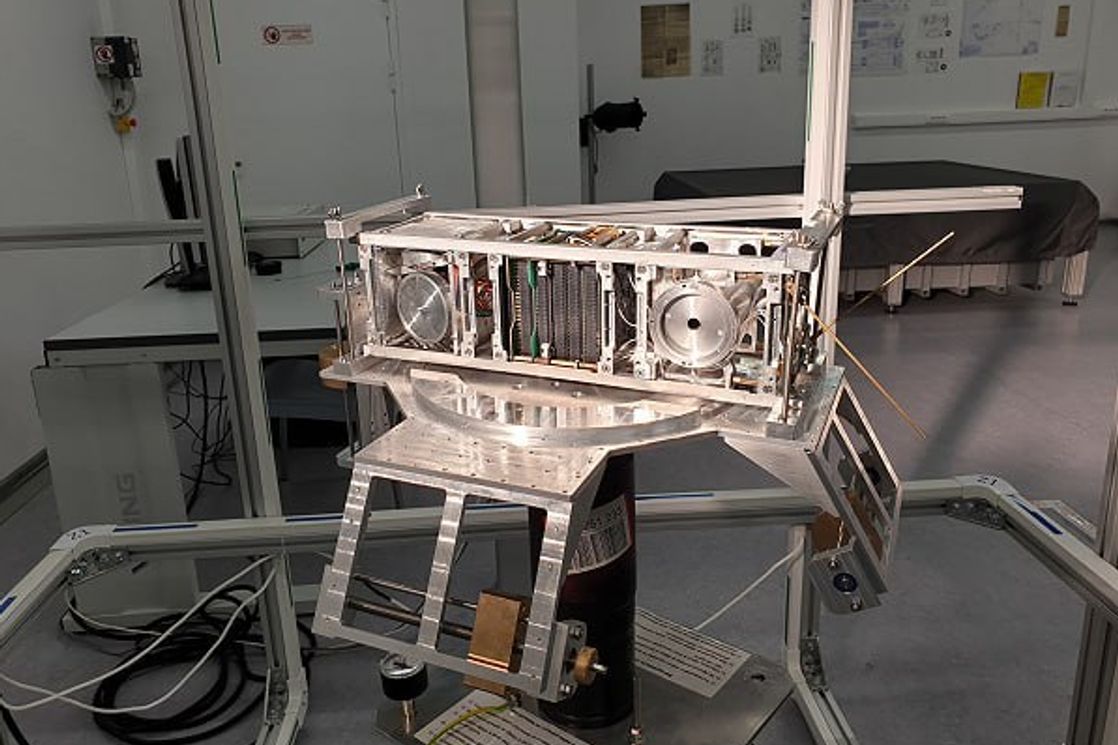
The reliability of the on-board electronics surpassed even optimistic forecasts: the total operating time of critical modules exceeded 35,000 hours without a single emergency restart. The chosen form of open channel, an AX.25 amateur radio format in the UHF range, played an important role. This meant that only the SatNOGS network of ground stations was able to receive and decrypt over 4,000 sessions (three leading observers monitored the broadcasts almost daily until the satellites’ orbits decayed), and each successfully decoded transmission appeared in real time in the open SatNOGS API.
The mission also served as a vibrant educational platform. Over the past four years, more than 15 students have taken part in the work of the MIEM Mission Control Centre, and Sirius students have had an opportunity to plan real orbital experiments for the first time, from drawing up daily transmission schedules to processing received telemetry. This experience gave rise to the idea of annual launches: in 2022 and 2023, CubeSX-HSE-2 and CubeSX-HSE-3 went into orbit with new payloads and improved modules.
The CubeSX-HSE and CubeSX-Sirius-HSE have achieved all their stated goals: demonstrating the performance of ultralight diffraction optics, collecting hundreds of valuable images, serving as an open data showcase for amateurs and professionals, and most importantly, training a new generation of small-spacecraft engineers. The CubeSats burned up at an altitude of about 80 km, but the code, data, and accumulated experience have already been passed on to the next participants of the Space-π programme. For them, the four-year record of the first university satellites is no longer an unattainable dream, but a new bar to pass.
Meanwhile, CubeSX-HSE-3, launched in June 2023, continues to operate in orbit. It transmits thousands of messages daily, and its telemetry confirms that the on-board electronics are operating normally and the solar panels are charging the batteries stably.
A new satellite will be sent into a Sun-synchronous orbit in the fourth quarter of 2025, while a sixth satellite focused on experiments with new materials is expected to be launched in 2026—thus tripling the amount of scientific data produced.
Dmitrii Abrameshin
Dmitrii Abrameshin, Head of the Mission Control Centre, Leading Engineer at the HSE Laboratory of Space Vehicles and Systems' Functional Safety, noted: ‘We demonstrated that HSE University can not only build a satellite, but also maintain its operation for a long time. CubeSX-HSE-3 has started providing fresh data for our archive, and the devices that we plan to launch in 2025 and 2026 will be capable of onboard data processing and prove that even a CubeSat can become a full-fledged orbital laboratory.’

See also:

Scientists Train Neural Network to Generate Process Plans from 3D Models
Researchers at the HSE FCS AI and Digital Science Institute have developed CAD2TechSpec, a framework that converts 3D models of mechanical parts into machining process plans—step-by-step instructions for machine tools. The solution aims to reduce the time required for the design and preparation of technical process documentation in mechanical engineering, aircraft manufacturing, and other high-tech industries. The study findings have been published in PeerJ Computer Science.
Biologists Discover 'Molecular Fingerprint' of Preeclampsia
Researchers at HSE University employed a new method to model hypoxia in placental cells during pregnancies complicated by preeclampsia and identified molecular markers of tissue hypoxia. Since hypoxia is one of the key mechanisms underlying preeclampsia, these findings are important for a more accurate and timely diagnosis of the disease and for the development of effective treatment methods. The paper has been published in Placenta.
‘Hedgehog’ Versus ‘Relatives’: Researchers Measure How the Brain Responds to Unexpected Words During Natural Speech
Russian neurophysiologists, including researchers from HSE University, have demonstrated the feasibility of using event-related fields (ERFs) to study brain activity during natural speech perception. The researchers showed that this approach can be applied not only to individual words but also to continuous speech. Their findings indicate that words whose meanings differ significantly from the preceding context require longer processing times. The study also reveals that the brain processes function words in two stages: first, it identifies their grammatical role and then uses this information to predict the next word. The study has been published in Frontiers in Human Neuroscience.
Hybrid Intelligence: Competencies in the Age of AI Discussed at Technoprom-2026
Artificial intelligence is not creating new professions, but rather transforming the nature of existing ones. This was the conclusion reached by participants in the panel session ‘Hybrid Intelligence: Digital and Human Drivers of Development,’ organised by the Institute for Statistical Studies and Economics of Knowledge (ISSEK) at HSE University as part of the 13th International Forum of Technological Development (Technoprom-2026). The experts discussed how the nature of work is changing, which skills are becoming increasingly sought after, and what prevents companies from fully capitalising on new technologies.
Scientists Develop New Solution for 6G Communication Systems
A terahertz neuromorphic circuit developed by scientists at HSE University could make 6G communication systems both more accurate and energy-efficient. The circuit enables indoor tracking of mobile devices with an accuracy of up to 99%. The results were presented at PIERS 2026, an international symposium on Photonics and Electromagnetism held in China.
Scientists Develop Algorithm for More Reliable Processors in Data Centres
Researchers from HSE MIEM and Samara University have developed the LRF-3D algorithm to automatically bypass idle nodes in three-dimensional networks-on-chip. Thanks to its hierarchical architecture, the algorithm outperforms existing solutions in both speed and path accuracy, improving processor reliability for use in data centres, supercomputers, and AI computing. The source code and test results are publicly available.
Researchers Develop Method for Direct Generation of Regulatory DNA
Researchers at HSE University have developed a model for generating promoters and enhancers—DNA sequences that regulate gene activity. The model works directly with DNA nucleotides, without first transforming them into a continuous numerical representation. This solution could be useful for applications in synthetic biology and gene therapy. The study results were presented at the ICLR 2026 Workshop ‘Generative AI in Genomics (Gen^2): Barriers and Frontiers.’
Researchers at HSE University and Sber Train Neural Networks to Better Predict User Preferences
The HSE FCS AI and Digital Science Institute and Sber have introduced a new architecture for recommendation systems that combines two classes of models, enabling algorithms to better predict users’ interests and needs. A preprint of the paper has been published on arxiv.org and presented at Urban ML.
Physicists Discover What Happens Inside a Stable Vortex
Large vortices with characteristic spiral arms are often observed in the atmosphere and the ocean. Physicists from HSE University have explained how these structures form and why they retain their shape. The researchers found that velocities at points located along the same vortex arc remain correlated even over long distances. At the same time, this correlation weakens rapidly with increasing distance from the vortex centre. These differences help explain the formation of spiral arms and may improve models of atmospheric and oceanic currents. The findings have been published in Physical Review Fluids.
HSE Computer Science Researchers Win Gold Medal at International Machine Learning Competition
A team comprising HSE International Laboratory of Statistical and Computational Genomics researchers Aleksei Shmelev and Nikita Chervov, 2025 graduate of the HSE Faculty of Computer Science’s Master’s programme in Data Analysis in Biology and Medicine Ivan Gevorkov, and two students from the United States achieved an outstanding result at the 2026 NeuroGolf international machine learning championship. The team won a gold medal and placed seventh overall.