

Centre for Language and Brain Conducts First Neurolinguistic Field Study of Reading in Yakut
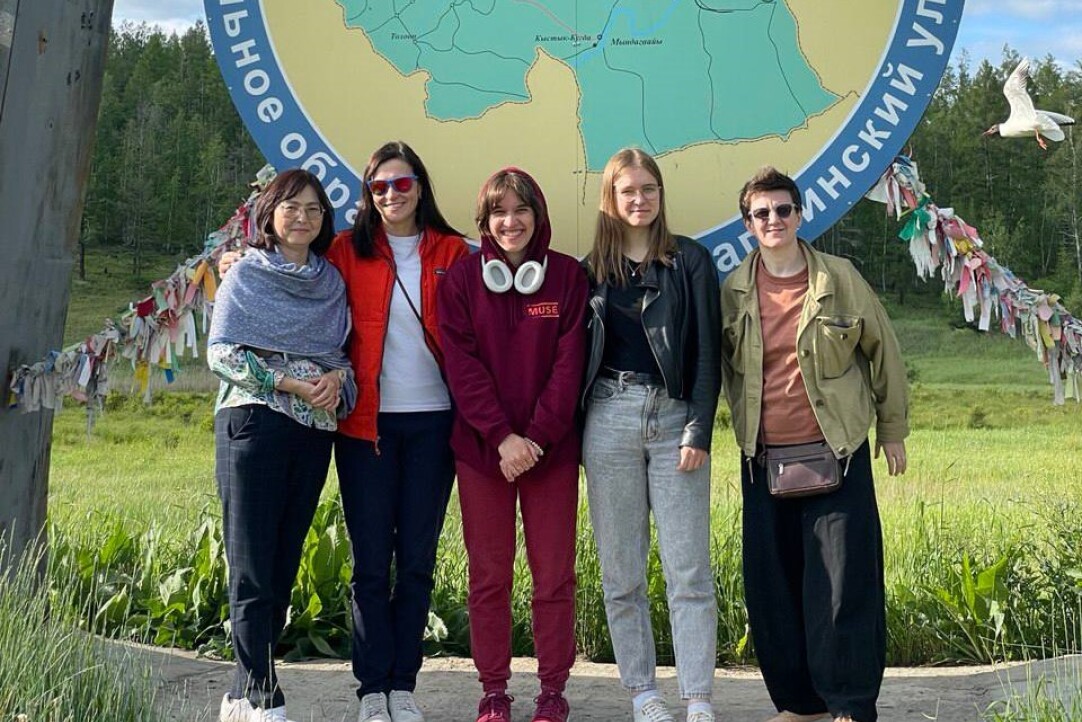
In July, a team from the HSE Centre for Language and Brain, in collaboration with the Centre for the Study, Preservation, and Development of Native Languages of the Academy of Sciences of the Republic of Sakha (Yakutia), conducted the first-ever neurolinguistic expedition to the village of Churapcha to study reading in the Yakut language using electroencephalography (EEG). For the first time, EEG data from 43 adults and behavioural data from 40 children was collected during the two-week expedition.
According to Olga Dragoy, Director of the HSE Centre for Language and Brain and head of the expedition, experimental linguistics worldwide still relies primarily on data from a small number of well-studied languages, mostly from the Indo-European family. As a result, she argues, it is methodologically unsound to draw universal conclusions about the nature of language from such a limited dataset. The objective of the Centre for Language and Brain is to expand both the geographical reach and linguistic diversity of experimental linguistics. Russia, with its multilingual population, offers unique opportunities for this, being home to languages from a wide range of families and groups.
Prior to this expedition, no psychoneurolinguistic research had ever been conducted using material from the Yakut language. The first experiment of this kind was carried out in Churapcha by a team consisting of Olga Dragoy, Olga Tuzhik, and Polina Pilipets from the Centre for Language and Brain and Nadezhda Vasilyeva from the Centre for the Study, Preservation and Development of Native Languages of the Academy of Sciences of the Republic of Sakha (Yakutia).





The choice of the village of Churapcha was intentional, as 99% of the local population speaks Yakut, making the Churapcha district a unique setting for studying native language perception in the context of active Yakut–Russian bilingualism.
During the two-week expedition, the team collected EEG data from 43 adults and behavioural data from 40 children. Adult participants were shown sentences containing incorrect tense coordination. The researchers recorded event-related brain potentials using EEG, enabling them to observe how the brain responds to different types of language errors.
‘The Yakut language distinguishes between an immediate past tense—eg, üleleetim, meaning "I have been working (recently)"—and a distant past tense, as in üleleebitim, meaning "I worked (a while ago)." We are interested in how the brains of native Yakut speakers respond to tense agreement errors between adverbs and verbs,' explains Polina Pilipets, Research Assistant at the HSE Centre for Language and Brain.
For instance, some sentences in the experiment combined the adverb bylyryyn ('a year ago,' indicating distant past) with a verb in the immediate past tense, or paired the adverb subu aghay ('just now,' indicating immediate past) with a verb in the distant past tense.

'According to preliminary surveys of native speakers, sentences that combine a distant-past adverb with a verb in the immediate past tense are perceived as more "incorrect." We expect this distinction to be reflected in the EEG signals—specifically, in the form of larger evoked potential amplitudes in response to the more prominent error,' comments Olga Tuzhik, Research Assistant at the HSE Centre for Language and Brain.
Alongside the EEG experiment, the team conducted behavioural testing with 40 bilingual children who speak both Yakut and Russian. The children completed cognitive tasks in both languages, including the RAVLT and the Trail Making Test in Russian, as well as tasks in Yakut. During the expedition, the researchers, in collaboration with linguists and native speakers, adapted the Russian-language LexiMetr test for assessing children's reading skills in Yakut and collected data in both languages.
'Adapting diagnostic tools for the Yakut language is of great importance, as it enables early diagnosis and support of children with reading difficulties. These tools are essential for both teachers and psychologists,' emphasises Nadezhda Vasilyeva, Leading Researcher at the Centre for the Study, Preservation and Development of Native Languages of the Academy of Sciences of the Republic of Sakha (Yakutia).

The expedition to Churapcha marked the first step toward a systematic study of the Yakut language using neurolinguistic methods. Moving forward, the researchers plan to examine aphasia in Russian–Yakut bilinguals. Similar studies have long been conducted in Russia with respect to the Russian language, but it remains unclear how aphasia manifests in Yakut or what specific language disorder patterns occur in native Yakut speakers. Yakutia offers all the necessary conditions for this research. In particular, the M.E. Nikolaev National Centre of Medicine is equipped with modern neurological and diagnostic facilities and has already expressed its willingness to collaborate.
'I would like to commend the excellent organisation of this expedition. It was the first time we experienced such a high level of collaboration: our colleagues from the Academy of Sciences of the Republic of Sakha (Yakutia) and the administration of the Churapcha district ensured flawless logistics, accommodation, and participant recruitment and motivation. It was truly an inspiring experience,' Olga Dragoy concluded.

See also:

HSE University to Present Its Projects at the International Youth Festival
The International Youth Festival (IYF) will be held in Yekaterinburg from 11 to 17 September 2026. HSE University will take an active part in the event. The university's booth will present a space settlement mock-up, robots, and the iFORA big data analysis system. Fifty HSE students will visit festival venues, and experts will participate in the business programme.
Biologists Discover 'Molecular Fingerprint' of Preeclampsia
Researchers at HSE University employed a new method to model hypoxia in placental cells during pregnancies complicated by preeclampsia and identified molecular markers of tissue hypoxia. Since hypoxia is one of the key mechanisms underlying preeclampsia, these findings are important for a more accurate and timely diagnosis of the disease and for the development of effective treatment methods. The paper has been published in Placenta.
‘Hedgehog’ Versus ‘Relatives’: Researchers Measure How the Brain Responds to Unexpected Words During Natural Speech
Russian neurophysiologists, including researchers from HSE University, have demonstrated the feasibility of using event-related fields (ERFs) to study brain activity during natural speech perception. The researchers showed that this approach can be applied not only to individual words but also to continuous speech. Their findings indicate that words whose meanings differ significantly from the preceding context require longer processing times. The study also reveals that the brain processes function words in two stages: first, it identifies their grammatical role and then uses this information to predict the next word. The study has been published in Frontiers in Human Neuroscience.
Scientists Develop Algorithm for More Reliable Processors in Data Centres
Researchers from HSE MIEM and Samara University have developed the LRF-3D algorithm to automatically bypass idle nodes in three-dimensional networks-on-chip. Thanks to its hierarchical architecture, the algorithm outperforms existing solutions in both speed and path accuracy, improving processor reliability for use in data centres, supercomputers, and AI computing. The source code and test results are publicly available.
Researchers Rank Recommendation Algorithms Using Sports Tournament Model
Researchers from the AI and Digital Science Institute at the HSE Faculty of Computer Science have developed an approach for selecting recommendation algorithms more effectively. Their approach uses pairwise comparisons of algorithms to create a tournament table, with the overall ranking based on their performance across all datasets in the tournament. This can reduce the number of algorithms that need to be tested when developing new services, saving both time and money. The study was presented at the 32nd ACM SIGKDD Conference on Knowledge Discovery and Data Mining (KDD 2026).
Researchers Develop Method for Direct Generation of Regulatory DNA
Researchers at HSE University have developed a model for generating promoters and enhancers—DNA sequences that regulate gene activity. The model works directly with DNA nucleotides, without first transforming them into a continuous numerical representation. This solution could be useful for applications in synthetic biology and gene therapy. The study results were presented at the ICLR 2026 Workshop ‘Generative AI in Genomics (Gen^2): Barriers and Frontiers.’
Researchers at HSE University and Sber Train Neural Networks to Better Predict User Preferences
The HSE FCS AI and Digital Science Institute and Sber have introduced a new architecture for recommendation systems that combines two classes of models, enabling algorithms to better predict users’ interests and needs. A preprint of the paper has been published on arxiv.org and presented at Urban ML.
Social Integration: At the Crossroads of Knowledge and Values
The International Laboratory for Social Integration Research (ILSIR) at HSE University studies the challenges faced by vulnerable groups and explores ways to help them participate fully in everyday life. To develop effective solutions, the laboratory’s researchers combine cutting-edge methods with practical fieldwork. In this interview with the HSE News Service, Laboratory Head Elena Iarskaia-Smirnova discusses the laboratory’s work.
HSE Graduate School of Business and Alfa-Bank Hold Summer School for Students from China
Twenty-seven students from Chinese universities took part in the international summer school ‘Digital Product Management’ organised by the HSE Graduate School of Business and Alfa-Bank. Over the course of a week, participants explored the Russian economy and business environment, learned about current technology trends, and worked through the key stages of digital product development step by step—from researching user needs and defining a problem to developing a prototype and presenting their final project.
Physicists Discover What Happens Inside a Stable Vortex
Large vortices with characteristic spiral arms are often observed in the atmosphere and the ocean. Physicists from HSE University have explained how these structures form and why they retain their shape. The researchers found that velocities at points located along the same vortex arc remain correlated even over long distances. At the same time, this correlation weakens rapidly with increasing distance from the vortex centre. These differences help explain the formation of spiral arms and may improve models of atmospheric and oceanic currents. The findings have been published in Physical Review Fluids.